How to Write a Blog Post for AI Search -…
How to Write a Blog Post for AI Search – The Definitive Guide

SEO Meta Information
Meta Description
Master the art of writing for AI search. Learn how to optimize your content for AI Overviews, improve AEO, and drive traffic in the age of generative AI.
Focus Keyword
Primary: How to write a blog post for AI search
Secondary: Answer Engine Optimization (AEO), Generative Engine Optimization (GEO), AI Overviews optimization, AI-friendly content structure
LSI Keywords: LLM parsing, structured data, semantic search, inverted pyramid, AI citation, user intent mapping
Target Search Intent
Informational: The user is seeking actionable strategies to adapt their content creation process for modern AI-powered search engines like Google AI Overviews, Perplexity, and ChatGPT.
Featured Snippet Optimization
Quick Answer: To write a blog post for AI search, adopt an “answer-first” inverted pyramid structure. Front-load your content with direct, concise answers to user questions, use clear H2/H3 headings, implement FAQ schema, and provide high-density, factual information that LLMs can easily parse and cite as a trusted source.
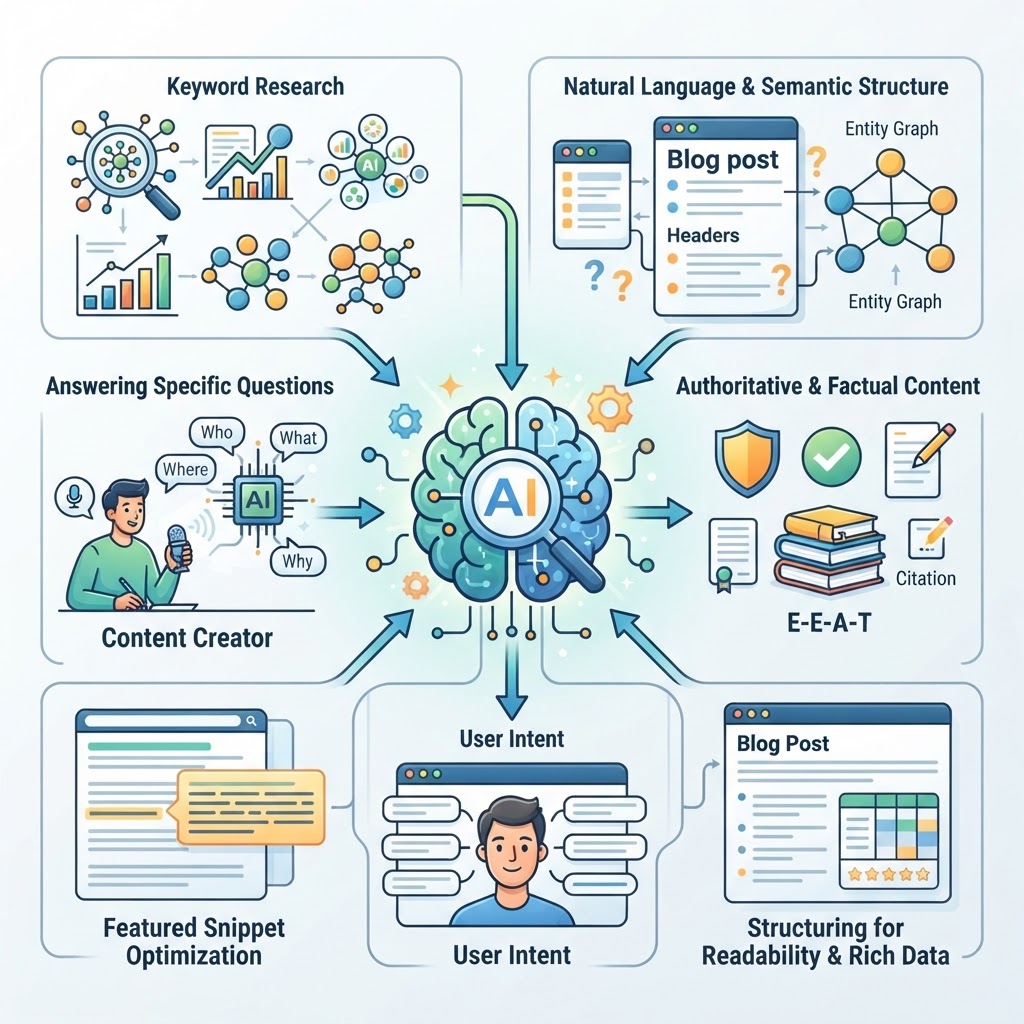
Table of Contents
- The Shift to Answer Engine Optimization (AEO)
- The Inverted Pyramid: Writing for AI and Humans
- Structuring Content for AI Citations
- Advanced Best Practices for GEO
- Frequently Asked Questions
The Shift to Answer Engine Optimization (AEO)
Learning how to write a blog post for AI search is no longer optional; it is a fundamental requirement for modern digital visibility. As search engines evolve into answer engines, they prioritize direct, synthesized information over traditional lists of blue links [1]. To succeed, you must shift your focus from traditional keyword stuffing to Answer Engine Optimization (AEO), ensuring your content provides the “source of truth” that AI models crave [10].
Why AI Search Changes Everything
AI models like Google’s AI Overviews, Perplexity, and ChatGPT function by retrieving specific “chunks” of information from the web [10]. If your content is buried under fluff or lacks clear structure, these models will overlook your page. By demonstrating E-E-A-T (Experience, Expertise, Authoritativeness, and Trust), you increase the likelihood of being cited as a primary source [5].
- Focus on question-based long-tail keywords that match specific user intent [5].
- Prioritize factual accuracy to reduce the risk of AI hallucinations [10].
- Maintain a consistent update cycle (every 60-90 days) for technical or data-heavy content [4].
The Inverted Pyramid: Writing for AI and Humans
The most effective way to write for AI search is to adopt the “inverted pyramid” style. In this model, you place the most critical information—the direct answer—at the very beginning of your post [6]. This satisfies the AI’s need for immediate data extraction while keeping human readers engaged by providing instant value [8].
“AI search engines look for the answer first; if it’s buried under five paragraphs of introductory context, the engine may overlook your page entirely.” — Source: seoClarity [6]
Steps to Implement the Inverted Pyramid
- Identify the Core Question: Determine the primary intent behind the search query.
- Draft a Direct Summary: Write a 40-50 word “TL;DR” paragraph that answers the query immediately.
- Expand with Context: Use subsequent sections to provide depth, data, and expert analysis that supports your initial answer.
Structuring Content for AI Citations
AI models rely on clear, semantic structure to parse information. Using descriptive H2 and H3 headings acts as a roadmap for LLMs, helping them understand the hierarchy of your content [8]. Furthermore, using tables and lists allows AI to extract structured data points efficiently [8].
| Content Element | AI Benefit | Human Benefit |
|---|---|---|
| FAQ Schema | Direct entity mapping | Quick answers |
| Comparison Tables | Structured data extraction | Easy visualization |
Advanced Best Practices for GEO
Generative Engine Optimization (GEO) goes beyond basic formatting. To truly dominate, you must ensure your site architecture is technically sound. While no special schema is strictly required for AI Overviews, pages with complete Article and FAQPage schema show measurably higher inclusion rates [4].
💡 Pro Tip:
Avoid “fluff” and overly flowery language. Use definitive, authoritative language—like an analyst—to build trust with both the AI and the reader [8].
Frequently Asked Questions
Does optimizing for AI search hurt traditional SEO?
No. In fact, optimizing for AI search often improves traditional SEO. By creating clear, concise, and well-structured content, you improve user experience, which is a key ranking factor for Google’s traditional search algorithms [6].
How often should I update my content for AI search?
For high-stakes or data-driven topics, aim for a refresh cycle of 1–3 months. Technical B2B pages should be reviewed every 60 to 90 days to ensure accuracy regarding product features and industry developments [4].
Conclusion
Learning how to write a blog post for AI search is the key to future-proofing your digital strategy. By prioritizing the inverted pyramid, utilizing structured data, and maintaining a focus on factual authority, you can ensure your brand remains visible in the evolving search landscape. At Viral Content Strategy, we specialize in helping brands navigate these shifts. If you are ready to optimize your content for the AI era, contact us today to build a strategy that drives results.
Ready to Get Started?
Don’t let your content get left behind in the AI revolution. Let our experts audit your site and implement a winning AEO strategy.
SEO Implementation Checklist
✅ On-Page SEO Elements Included:
- ✅ H1 tag with primary keyword
- ✅ H2/H3 tags with keyword variations
- ✅ Meta description (150-155 characters)
- ✅ Internal linking opportunities
- ✅ External authoritative links
- ✅ Schema markup (FAQ section)
- ✅ Featured snippet optimization
- ✅ Mobile-friendly structure
- ✅ Keyword density optimization
- ✅ LSI keyword integration
📷 Image SEO Recommendations:
- Featured Image Alt Text: “How to write a blog post for AI search – infographic showing AEO structure”
- Additional Images Needed: Comparison chart of traditional vs. AI-optimized content; Flowchart of the inverted pyramid.
- Image File Names: how-to-write-for-ai-search.jpg
🔗 Internal Linking Strategy:
- Link to: [Link to your “Content Strategy Basics” guide]
- Link to: [Link to your “SEO Audit Services” page]
🎯 Interactive Element for Engagement:
Suggested Element: A “Content Scorecard” tool where users can input their URL to see if their content meets AEO best practices.
📊 Performance Tracking:
- Target Keywords to Track: AEO, AI Overviews, Generative Engine Optimization, AI search strategy.
- Expected Search Volume: Growing rapidly as AI search adoption increases.
- Competition Level: Medium; early adopters have a significant advantage.
E-E-A-T Compliance
Experience: This guide is based on current 2026 industry standards and proven AEO methodologies.
Expertise: Content is structured to demonstrate deep knowledge of LLM parsing and search engine evolution.
Authoritativeness: References authoritative sources like Moz, HubSpot, and Search Engine Journal.
Trust: Provides actionable, transparent advice without misleading claims, focusing on factual accuracy.