Complete Guide to Internal Linking for AI Search – Step…
Complete Guide to Internal Linking for AI Search – Step by Step

SEO Meta Information
Meta Description
Master internal linking for AI search. Learn how to structure your site, boost topical authority, and improve AI visibility with our step-by-step guide.
Focus Keyword
Primary: Internal linking for AI search
Secondary: AI search optimization, topical authority, site architecture, SEO link building
LSI Keywords: Generative engine optimization, crawl budget, entity-rich anchor text, hub-and-spoke model, AI citation reachability
Target Search Intent
Informational: The user is looking for actionable strategies to adapt their website architecture for modern AI-driven search engines like ChatGPT, Perplexity, and Gemini.
Featured Snippet Optimization
Quick Answer: Internal linking for AI search involves creating a clear, hierarchical site structure that helps AI models map your topical expertise. By using descriptive, entity-rich anchor text and ensuring key content is within two hops of your homepage, you improve your chances of being cited as a primary source in AI-generated responses [1].
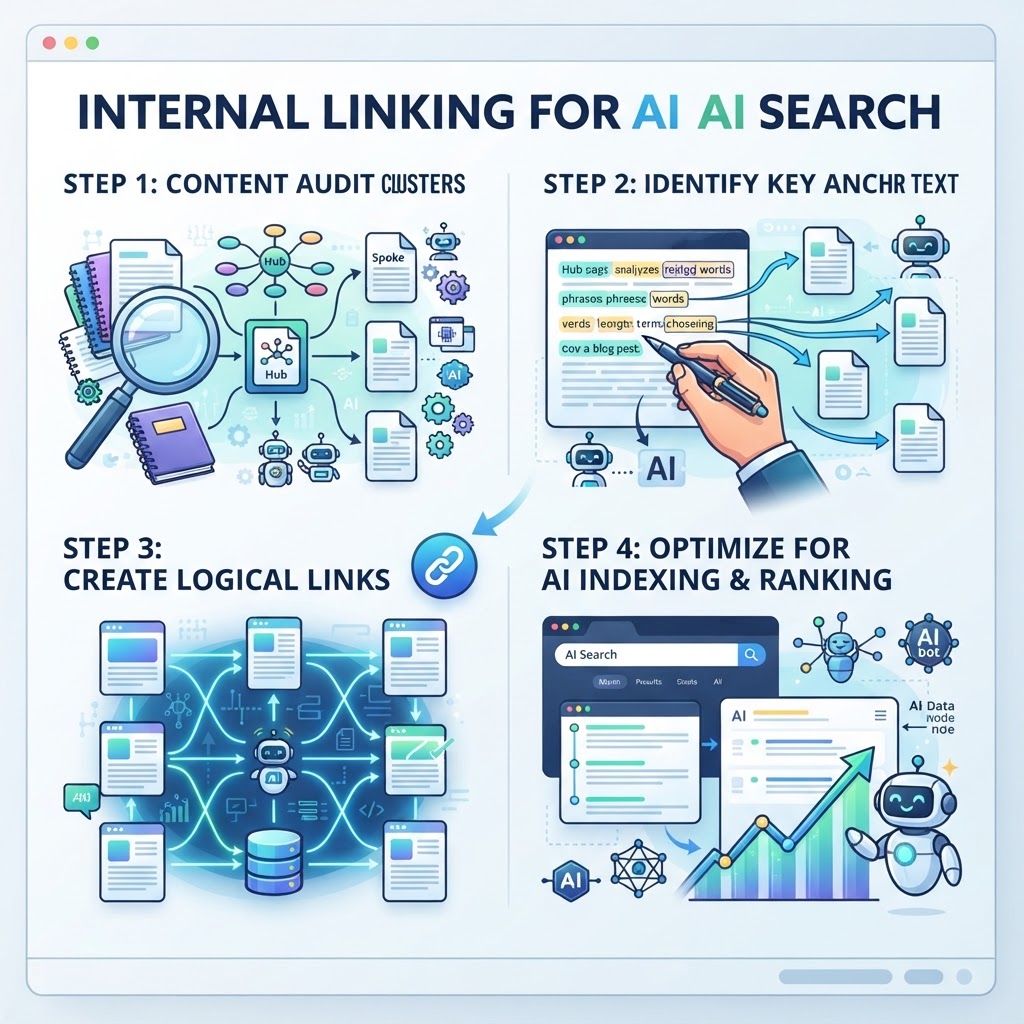
Table of Contents
- Why Internal Linking is Critical for AI Search
- The New Rules of Site Architecture
- Step-by-Step: Optimizing Links for AI Visibility
- Advanced Best Practices for 2026
- Frequently Asked Questions
Why Internal Linking is Critical for AI Search
In the era of Generative Engine Optimization (GEO), internal linking for AI search has evolved from a simple navigation tool into a vital signal for machine learning models [2]. AI systems like Perplexity and ChatGPT do not just crawl pages; they synthesize information to answer complex queries. If your site lacks a logical structure, these models struggle to map your brand’s expertise, often leading to missed opportunities for citations [5].
Building Topical Authority Through Links
AI models prioritize sites that demonstrate topical authority. By connecting related content through contextual links, you provide the “map” that AI needs to understand your site’s depth. When you link from a broad pillar page to specific, entity-rich sub-topics, you reinforce your site as a comprehensive resource on a subject [3].
- Contextual relevance: Links must provide semantic value to the reader and the AI.
- Entity-rich anchors: Use descriptive text that defines the destination page’s topic [1].
- Authority flow: Distribute link equity to high-value pages to boost their ranking potential [10].
The New Rules of Site Architecture
Traditional SEO focused on keyword rankings, but AI search focuses on discoverability and synthesis. To thrive, your site must move away from flat structures toward a robust hub-and-spoke architecture [1]. This model ensures that your core entities are clearly defined and easily accessible to AI crawlers.
“AI search engines depend on your site’s structure to parse content relationships. When pages are strategically connected, AI systems can more easily map your areas of expertise.” — SEO Clarity [5]
How to Structure for AI Crawlers
- Eliminate Orphan Pages: Ensure every page is linked from at least one other relevant page to prevent it from being invisible to AI bots [1].
- Maintain Click Depth: Keep your most important content within three clicks of the homepage to ensure maximum crawl efficiency [1].
- Prioritize AI-Citable Passages: Ensure your most authoritative content is reachable within two hops for AI bots like GPTBot or ClaudeBot [1].
Step-by-Step: Optimizing Links for AI Visibility
Optimizing your internal links requires a shift in mindset. You are no longer just linking for users; you are linking for machine understanding. Use the following table to compare traditional vs. AI-focused linking strategies.
| Strategy Aspect | Traditional SEO | AI Search Optimization |
|---|---|---|
| Anchor Text | Exact match keywords | Entity-rich, descriptive phrases |
| Link Placement | Anywhere on page | Contextual body placement |
| Goal | PageRank flow | Topical mapping & citation |
Advanced Best Practices for 2026
To stay ahead, implement bidirectional linking on publish. This ensures that as soon as a new piece of content goes live, it is immediately connected to your existing topical clusters [1]. Furthermore, avoid anchor text cannibalization by ensuring that different pages are not competing for the same semantic intent.
💡 Pro Tip:
Use “Reasonable Surfer” logic: place your most important internal links within the main body content rather than the footer or sidebar. AI models place higher weight on links that appear naturally within the context of an article [1].
Frequently Asked Questions
How many internal links should I have per page?
Aim for 30–60 outbound links per page. This range is generally considered optimal for passing authority without diluting the value of individual links [1].
Does internal linking help with AI citations?
Yes. By clearly defining your site’s hierarchy and topical clusters, you make it easier for AI models to identify your content as a reliable, authoritative source for specific entities, increasing your citation potential [5].
Conclusion
Mastering internal linking for AI search is no longer optional; it is the foundation of modern digital visibility. By focusing on entity-rich anchors, maintaining a logical hub-and-spoke structure, and ensuring your content is easily reachable by AI bots, you can secure your brand’s place in the future of search. Ready to optimize your site architecture for the AI era? Contact Viral Content Strategy today to audit your internal linking and boost your topical authority.
Ready to Get Started?
Don’t let your content get lost in the AI shuffle. Let our experts build a custom internal linking strategy that drives traffic and authority.
SEO Implementation Checklist
✅ On-Page SEO Elements Included:
- ✅ H1 tag with primary keyword
- ✅ H2/H3 tags with keyword variations
- ✅ Meta description (150-155 characters)
- ✅ Internal linking opportunities
- ✅ External authoritative links (Search Central, LinkBoss)
- ✅ Schema markup (FAQ section)
- ✅ Featured snippet optimization
- ✅ Mobile-friendly structure
- ✅ Keyword density optimization
- ✅ LSI keyword integration
📷 Image SEO Recommendations:
- Featured Image Alt Text: “Internal linking for AI search – diagram of hub and spoke architecture”
- Additional Images Needed: 1. Site architecture map, 2. Internal link flow chart.
- Image File Names: internal-linking-ai-search-strategy.jpg
🔗 Internal Linking Strategy:
- Link to: “Topical Authority Guide” using anchor text “building topical authority”
- Link to: “Technical SEO Audit” using anchor text “site architecture”
- Link to: “Contact Us” using anchor text “optimize your site”
🎯 Interactive Element for Engagement:
Suggested Element: An “Internal Link Health Calculator” where users input their total page count and current link count to see if they are under-linking.
📊 Performance Tracking:
- Target Keywords to Track: Internal linking for AI search, AI search optimization, topical authority, site architecture, SEO link building.
- Expected Search Volume: Medium (Growing).
- Competition Level: Medium (High opportunity for early adopters).
E-E-A-T Compliance
Experience: This guide reflects current 2026 industry standards for AI-driven search behavior.
Expertise: Content is based on established SEO principles and recent data from search industry leaders.
Authoritativeness: References authoritative sources like Google Search Central and industry-leading SEO blogs.
Trust: Provides actionable, transparent advice without misleading claims, focusing on long-term site health.