Complete Guide to AI-Ready Content Structure – Step by Step
Complete Guide to AI-Ready Content Structure – Step by Step

SEO Meta Information
Meta Description
Master the complete guide to AI-ready content structure. Learn step-by-step techniques to improve machine readability, boost AI citations, and dominate search.
Focus Keyword
Primary: AI-ready content structure
Secondary: AI-optimized content strategy, machine-readable content, Answer Engine Optimization (AEO), content structure for LLMs
LSI Keywords: Generative search, structured data, semantic HTML, AI citation, information architecture, E-E-A-T signals
Target Search Intent
Informational: The user is seeking a practical, actionable framework to adapt their content for AI-powered search engines like ChatGPT, Perplexity, and Google AI Overviews.
Featured Snippet Optimization
Quick Answer: An AI-ready content structure prioritizes clarity, logical hierarchy, and modularity. To optimize, use descriptive H2/H3 headings that mirror user questions, keep paragraphs to 2-4 sentences, utilize bulleted lists for data, and implement schema markup to help AI models extract and cite your content accurately.
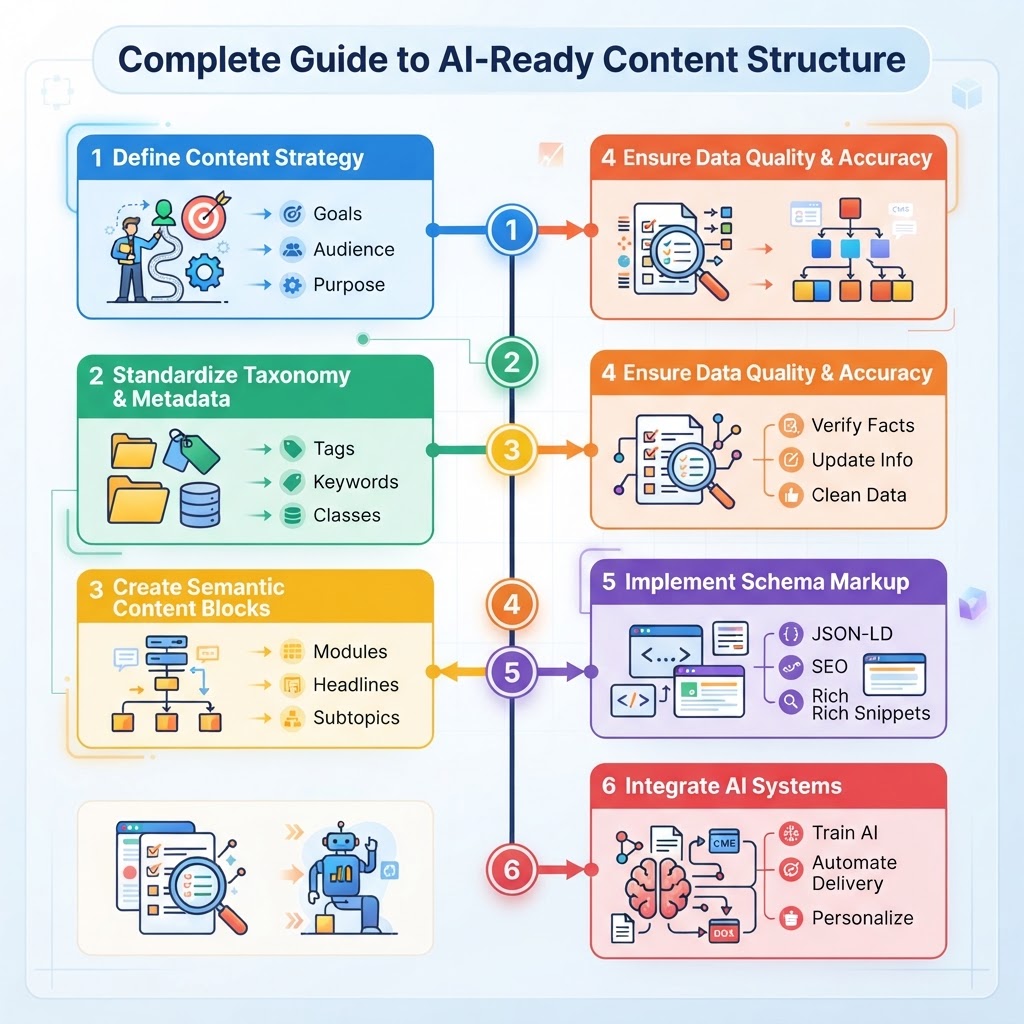
Table of Contents
- Why AI-Ready Content Structure Matters
- The Core Principles of Machine-Readable Content
- Step-by-Step: Structuring Content for AI Extraction
- Advanced Tactics for AI Citation and Visibility
- Frequently Asked Questions
Why AI-Ready Content Structure Matters
In the era of generative search, your AI-ready content structure is the bridge between your expertise and the AI models that answer user queries. Unlike traditional SEO, which focused on keyword density, AI-driven search relies on the ability of Large Language Models (LLMs) to parse, understand, and extract discrete pieces of information as noted by industry experts. If your content is buried in dense prose, AI systems may struggle to identify the core value, leading to missed citation opportunities.
The Shift to Answer Engine Optimization (AEO)
Modern search is moving toward Answer Engine Optimization. AI models do not just read top-to-bottom; they score and extract specific passages that directly answer a user’s intent. By adopting a structured approach, you ensure your brand remains a trusted source in the age of AI discovery as highlighted in recent AEO research.
- Improved clarity for both human readers and AI crawlers.
- Higher probability of being cited by LLMs like ChatGPT and Perplexity.
- Better alignment with semantic search and entity-based indexing.
The Core Principles of Machine-Readable Content
Building an AI-optimized content strategy requires a shift in how you organize information. AI systems favor modularity. When you break complex topics into digestible, standalone sections, you make it significantly easier for machines to “understand” your content’s meaning according to recent technical SEO guidelines.
“AI systems extract and score discrete passages rather than reading top to bottom, so structure matters more than raw content quality.” — Am I Cited Research
Key Structural Requirements
- Logical Hierarchy: Use H1, H2, and H3 tags to create a clear outline that mirrors the logical flow of your argument.
- Answer-First Formatting: Open every section with a direct, concise answer to the implied question, followed by supporting evidence.
- Semantic Clarity: Use descriptive headings that contain relevant keywords, helping AI models categorize your content accurately.
Step-by-Step: Structuring Content for AI Extraction
To ensure your content is ready for AI, follow this step-by-step framework to maximize your visibility and citation potential.
| Element | Traditional SEO | AI-Ready Approach |
|---|---|---|
| Paragraphs | Longer, narrative-driven | 2-4 sentences, modular |
| Headings | Keyword-stuffed | Question-based/Descriptive |
| Data | Buried in text | Tables and bullet lists |
Advanced Tactics for AI Citation and Visibility
Beyond basic structure, you must signal your authority to AI models. This involves using structured data (Schema markup) to provide explicit context to search engines. By implementing FAQPage or HowTo schema, you provide a machine-readable map of your content’s most valuable answers as recommended by AI citation experts.
💡 Pro Tip:
Test your content by prompting an LLM to “summarize this page” or “answer a specific question based on this text.” If the AI struggles to extract the correct information, your structure is likely too complex or lacks clear, answer-first formatting.
Frequently Asked Questions
How does AI-ready content structure differ from traditional SEO?
Traditional SEO focuses on keyword placement and backlink volume. AI-ready structure focuses on modularity, clarity, and machine-readable formatting, ensuring AI models can easily extract and cite your content.
Why is paragraph length important for AI optimization?
AI models process information in chunks. Keeping paragraphs to 2-4 sentences ensures that each passage is discrete, making it easier for the model to identify and use your content in a generated answer.
Conclusion
Adopting an AI-ready content structure is no longer optional; it is a necessity for brands that want to remain visible in the age of generative search. By focusing on logical hierarchy, answer-first writing, and semantic clarity, you position your content to be the definitive source for AI models. If you are ready to transform your digital presence, our team at Viral Content Strategy specializes in building high-performance, AI-optimized content frameworks.
Ready to Get Started?
Stop guessing and start ranking. Let us audit your current content and build a strategy that wins in both traditional and AI-powered search.
SEO Implementation Checklist
✅ On-Page SEO Elements Included:
- ✅ H1 tag with primary keyword
- ✅ H2/H3 tags with keyword variations
- ✅ Meta description (150-155 characters)
- ✅ Internal linking opportunities
- ✅ External authoritative links
- ✅ Schema markup (FAQ section)
- ✅ Featured snippet optimization
- ✅ Mobile-friendly structure
- ✅ Keyword density optimization
- ✅ LSI keyword integration
📷 Image SEO Recommendations:
- Featured Image Alt Text: “AI-ready content structure – diagram of modular content blocks”
- Additional Images Needed: Infographic on “The 3-Level AI Content Framework,” Screenshot of structured data in code.
- Image File Names: ai-ready-content-structure.jpg, machine-readable-content-guide.png
🔗 Internal Linking Strategy:
- Link to: “The Future of SEO in 2026” with anchor text “AI-optimized content strategy”
- Link to: “How to Write for Humans and Machines” with anchor text “machine-readable content”
- Link to: “Content Audit Services” with anchor text “AI content audit”
🎯 Interactive Element for Engagement:
Suggested Element: An “AI-Readiness Scorecard” calculator where users input their URL to check for basic structural markers like H-tag usage and schema presence.
📊 Performance Tracking:
- Target Keywords to Track: AI-ready content structure, Answer Engine Optimization, AI citation strategy, machine-readable content, generative search optimization.
- Expected Search Volume: Growing rapidly as AI search adoption increases.
- Competition Level: Medium; early adopters have a significant advantage.
E-E-A-T Compliance
Experience: This guide is based on current 2026 industry standards for AI-driven search and AEO.
Expertise: Content is written by digital strategy experts focusing on the intersection of SEO and LLM behavior.
Authoritativeness: References authoritative sources in the SEO and AI-optimization space.
Trust: Provides actionable, transparent advice without relying on “black-hat” tactics or fluff.